Size your Wi-Fi
before you deploy
Predictive design from floor plans, design validation by APoS or a post-deployment validation survey: we size and position your access points against your RF objectives for coverage, capacity and mobility.
No time to book? Leave your number and we’ll call you back →
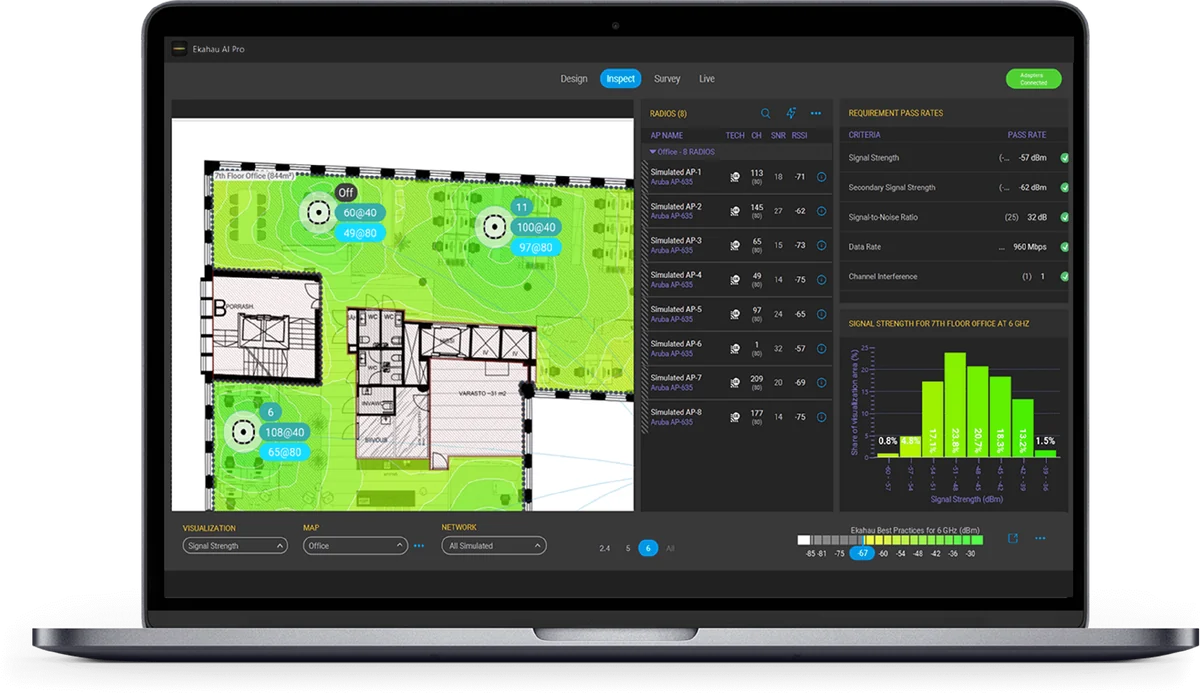
- ✓ A number and placement of access points justified by RF objectives.
- ✓ Documented assumptions: materials, usage, devices, density and mobility.
- ✓ A design your IT department or integrator can use, with no vendor lock-in.
- ✓ An approach suited to offices, warehouses, industry and complex environments.
Predictive, APoS or validation: a different answer at each stage
The level of measurement depends on the project stage, the complexity of the building and the acceptable level of risk.
Predictive design from floor plans
RF modelling based on floor plans, materials, heights, usage and equipment characteristics. Ideal for sizing a new site or checking a layout before building work.
Deliverable: AP placement + heatmaps + design assumptions.
On-site APoS
An access point is temporarily placed at the planned locations and measured with professional tools. The goal is to characterise real RF propagation and validate the planned locations before the design is frozen.
Recommended: warehouses, industry, complex materials, high ceilings.
Post-deployment validation
After installation, a validation survey checks that the deployed network meets the defined RF criteria: RSSI, SNR, secondary coverage, capacity and service continuity on the move.
Goal: measure the result, not assume it has been achieved.
APoS in practice: a real access point, at its mounting height, measured on site before the layout is approved.


A coverage study is not just about “having signal”
The design is built around the applications and devices that will actually use the network.
RSSI & SNR
Signal thresholds and signal-to-noise ratio suited to the applications and Wi-Fi clients.
Secondary coverage
Controlled secondary coverage so devices can roam, according to their capabilities and trigger thresholds.
Capacity & density
Number of users, devices, applications and activity peaks built into the sizing.
2.4 / 5 / 6 GHz
Band planning, channel widths, frequency reuse, DFS constraints and applicable regulations.
Materials & geometry
Concrete, partitions, racking, machinery, height and volumes strongly affect RF propagation.
Business devices
Scanners, VoWiFi, AGVs/AMRs, IoT or laptops: the network is designed for the actual equipment.
Designing for 6 GHz and Wi-Fi 7
Moving to Wi-Fi 6E or Wi-Fi 7 is not simply a matter of replacing each access point in its current location. 6 GHz propagation, the real capabilities of client devices, channel widths and capacity needs may require the number and position of access points to be revisited.
What the study checks
- 5 GHz and 6 GHz coverage analysed separately
- Actual share of 6 GHz-capable devices
- Channel widths suited to density and available spectrum
- Density and placement needed for the target applications
- Cabling, uplink and PoE power constraints relevant to the project
From business need to placement plan
Scoping
Scaled floor plans, site constraints, devices, applications, RF objectives and mobility requirements.
Modelling
Building the radio model, choosing APs and antennas, and a first layout with Ekahau or Hamina.
Field validation if needed
APoS measurements to test propagation assumptions and planned locations against the site's real RF behaviour when predictive design alone is not enough.
Usable deliverable
Plans, heatmaps, design parameters, recommendations and points of attention for the deployment.

Predictions are checked on site
A predictive study sets the layout. On-site measurement confirms or corrects it: after installation, critical areas are walked to check signal, SNR and secondary coverage.
- Walking the aisles, docks and picking areas
- Prediction and measurement compared, area by area
- Adjustments documented before handover
A technical file you can actually deploy from
Design & placement
- Number, model and position of the access points
- Selected frequency bands and channel widths
- Transmit powers and design assumptions
- RSSI, SNR and secondary coverage heatmaps, depending on scope
Decisions & recommendations
- Identified constraints and risk areas
- Cabling and mounting recommendations relevant to the RF design
- RF criteria for post-deployment validation
- A report that IT, network teams and the integrator can all follow
If your Wi-Fi already exists and performs poorly, start with an audit
Disconnections, unstable roaming, DFS, interference, insufficient coverage or degraded performance: move from design to diagnosing the real network.
Examples: from site survey to a Wi-Fi 7 migration plan on an industrial site → · diagnosing instability after a Wi-Fi 7 deployment →
Business or integrator: the same RF standards
You are a business
You are preparing a new site, a refurbishment or a Wi-Fi migration. TWN brings an independent view to size the network and provide a technical specification your teams or integrator can use.
See our services for businesses →You are an integrator or MSP
You need occasional RF expertise to secure a pre-sales phase, carry out an APoS or produce your client's coverage study. TWN can step in as technical support or under a collaboration model agreed together.
See our partner programme →Ekahau-certified Wi-Fi expertise
Studies carried out with professional tools and a documented RF methodology.

Ekahau AI Pro, Ekahau Sidekick 2 and Hamina
TWN Consulting combines predictive modelling, APoS measurements and RF analysis to match the level of study to the project's risk. The goal: a design that is technically justified, documented and verifiable by a validation survey after deployment.
Wi-Fi coverage study: questions to settle before the project
What is a Wi-Fi coverage study?
When should a Wi-Fi coverage study be carried out?
What is the difference between a predictive study and an APoS study?
Which criteria are used to size the Wi-Fi?
Which deliverables do you provide?
Can you work for an integrator or under their brand?
Do you work outside France?
Let's talk about your study
30 minutes to scope your needs, your floor plans and the site's RF constraints. We point you to the right method, with no obligation.